
Paint as Law: The Penalty Area and the Free-Kick Wall
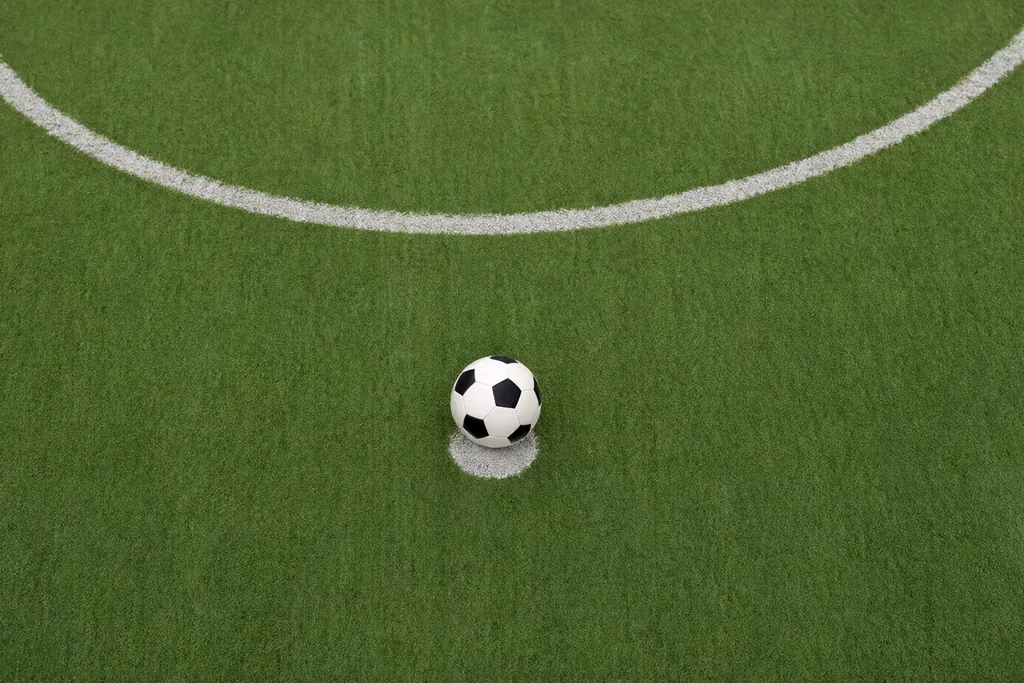
The most argued-about line on a football pitch is not the goal line and not the halfway line. It is the painted rectangle in front of each goal, the arc attached to it, and the invisible barrier that keeps defenders at a minimum distance from a dead ball. Those markings shape where fouls are punished, where the goalkeeper may use his hands and how a free kick is taken, and every one of them was drawn by argument.
The penalty area and the free-kick wall are the two great spatial inventions of the game. One turned a foul into a set-piece with a defined geography; the other tried to give the attacking team a fair chance to play the ball without being charged down.
Where the goalkeeper could use his hands
In the earliest codified football the goalkeeper could handle the ball anywhere in his own half, which made him a third centre-back with gloves. That privilege was steadily cut back as the game began to prize outfield skill, and the arrival of a fixed area around the goal drew the first territorial boundary in the sport.
The line mattered because it changed the meaning of a foul. Inside the new area, a defender who handled or tripped an opponent conceded a penalty from a fixed spot with only the goalkeeper to beat. Outside it, the punishment was a free kick and a wall. Two different games now existed on the same pitch, divided by paint.
- Handling privileges were gradually confined to the penalty area.
- A fixed area created a penalty spot with a defined distance to goal.
- The arc was added so players could stand the correct distance from the spot.
- The same area later became the offside reference and the goalkeeper's domain.
The arc, the spot and why geometry mattered
A penalty taken from a point hedged by bodies is not a penalty. Once the spot was fixed, the painted arc was added to keep everyone except the taker and the goalkeeper outside a defined radius, and referees gained a visible tool for a rule that would otherwise be guesswork. The marking exists purely so that the law can be enforced by eye.
The same principle governs the wall. A defending team may not stand closer to the ball than the distance set in the laws, and the referee's job is to pace it out and hold the line until the kick is taken. It is one of the few moments in football where the referee physically builds the geometry of the game.
Why the wall kept getting gamed
Any rule expressed as a distance will be attacked at its edges. Defenders learned to time their charge at the ball the instant it was struck, to shuffle forward a step before the referee looked, and to add and remove bodies to disguise who would attack the ball. Attackers responded by crowding the wall, standing in the goalkeeper's eyeline and inventing routines to move the ball a fraction sideways.
| Rule element | Purpose | Exploit it invited |
|---|---|---|
| Penalty spot | A fixed, fair position to strike from | Stutter runs and deliberate delays |
| Painted arc | Keep players out of the taker's path | Encroachment a step at a time |
| Minimum distance for a wall | Give the attacker room to play the ball | Charging down a moving ball |
| Attacking players in the wall | Nothing originally | Blocking and unsighting the keeper |
| Stationary ball on a free kick | A clean, repeatable restart | Rolling the ball to gain an angle |
The small changes that reshaped the set piece
Modern rule-making has gone after the exploits rather than the distances. Attacking players who stand in a defensive wall must now keep a required gap from it, so that the wall cannot be split and the goalkeeper's view cannot be legally blocked. Free kicks have been recategorised so that a restart inside the area is treated as a different problem from one on the wing.
Defenders also lost one of their oldest tricks, since a ball that is not stationary when it is struck can no longer be rolled sideways to open a shooting angle. Each of these adjustments is tiny in wording and enormous in effect: a free kick near the box now looks nothing like the same free kick thirty years ago.
The penalty area as a second pitch
The area's influence has grown far beyond fouls. It is the boundary for the back-pass restriction, the reference for the goalkeeper's handling rights, the zone that governs where a goalkeeper may hold the ball for a limited period, and the target for every corner routine ever drawn. One painted rectangle became the most contested geography in the sport.
Tactically it produced the specialist. Set-piece coaches, dedicated takers, rehearsed blocking patterns and zonal marking systems all exist because a foul in one place on the field is worth far more than a foul in another. The line made some ground expensive and the rest of the pitch cheap.
The lesson painted on the grass
Football's markings are the most practical part of its law book. They convert abstract rules into things a referee can enforce without instruments and a child can understand from the touchline. That is why they have survived so long with so little alteration, and why the changes around them came from behaviour rather than geometry.
The next time a free kick is awarded at the edge of the area and a wall is assembled step by step, watch the referee build the shape of the game with his feet. The rules of the box were drawn a long time ago, and every trick at either end of them is a footnote to that paint.
Keep digging in the vault

Olympe VIP Elysium: rungs, 2500 € cap and when not to chase
The badge does not skip KYC. Let the club follow volume you were already playing.
2026-09-08
The Match Ball: Weight, Panels and the End of the Wet-Weight Problem
The laws never named a material, a panel count or a pressure. The ball rewrote what players could physically do anyway.
2026-09-07
The Bench Was Illegal: How Substitutes Won Their Place
For nearly a century a team was the eleven who started. The bench arrived because one injury made the old rule impossible to defend.
2026-09-06