
From Leather to Latex: How Boots and Balls Evolved

Players at the first World Cup in 1930 headed a leather ball that could nearly double its weight in the rain, wearing ankle boots closer to workwear than to work gear. Their modern descendants strike a thermally bonded synthetic sphere in 200-gram boots knitted like socks. Football's laws stayed recognisable for a century; its tools changed beyond recognition, and the sport changed with it.
Every technical development in the game, from the knuckleball free-kick to the 50-metre switch of play, runs through the history of the ball and the boot. This is that history, told through the objects themselves.
Leather, laces and the wet-weight problem
The Victorian ball was an inflated pig or cow bladder inside a leather case, closed with laces. It was never truly round, and its fatal flaw was absorption: untreated leather soaked up water, and a wet ball on a heavy pitch became a health hazard. Head injuries and worse were blamed on sodden leather, and players of that era who headed constantly paid for it in later life, a link modern dementia studies of older players have repeatedly examined.
The 1930 World Cup final was famously played with two different balls after Argentina and Uruguay argued over the choice, one half with each. Waterproofing improved through mid-century, the laces disappeared as valves and interlocking panels took over, and the white ball was permitted in 1951 so floodlit crowds could actually see it.
- Early balls: leather case, pig-bladder inside, lace-up closure, far from spherical.
- 1951: the white ball authorised for visibility under floodlights.
- 1970: the 32-panel black-and-white Telstar becomes the icon of the TV age.
- 1986: the Azteca is the first fully synthetic World Cup ball, ending the water-retention problem for good.
From Telstar to Teamgeist: the synthetic age
The 1970 Telstar, thirty-two hand-stitched panels in black and white, was designed for colour-era television and became the default picture of a football in everyone's head. Synthetic coatings through the 1970s and full synthetic construction from 1986 made balls consistent, waterproof and faster. The 2006 Teamgeist cut the panel count to fourteen; the 2010 Jabulani went to eight and flew so unpredictably that goalkeepers and strikers complained in unison, a rare moment of football unity.
Today's match balls are thermally bonded, textured for aerodynamics, and embedded with a sensor that feeds the semi-automated offside system 500 data points per second. The ball has become a measuring instrument.
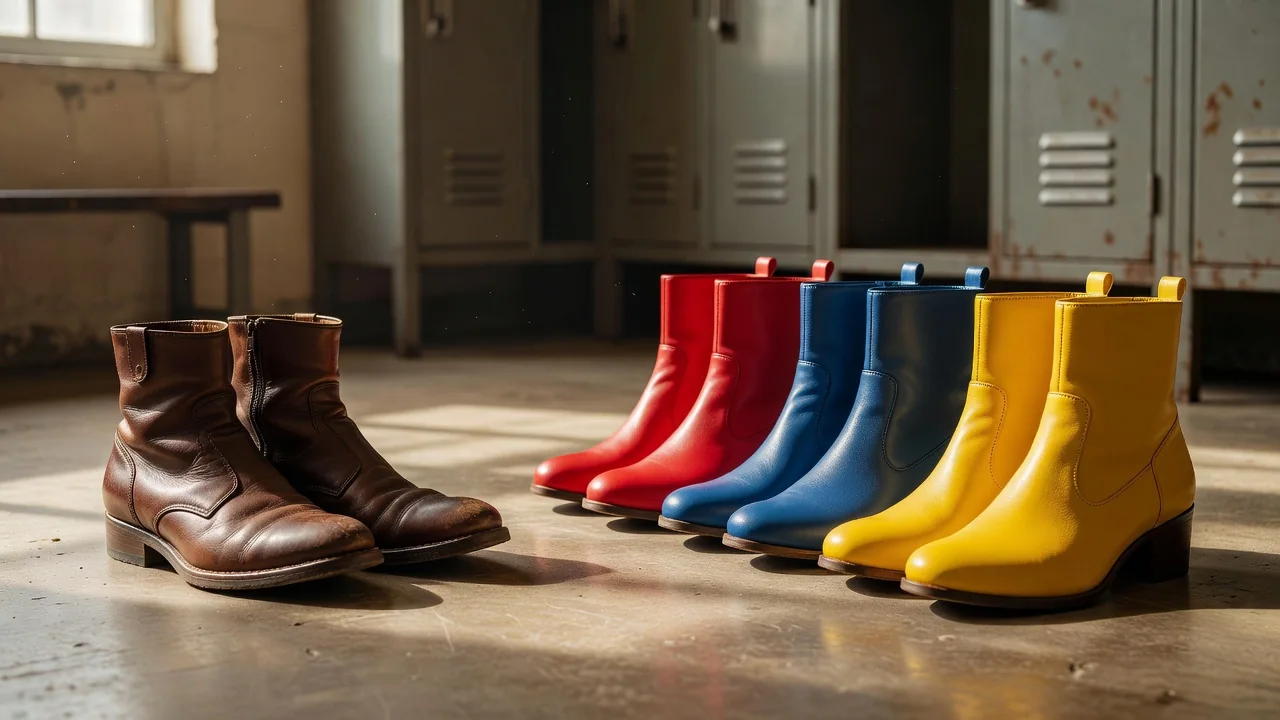
The boot: from toecap to knitted skin
Boots followed the same arc from armour to instrument. The 19th-century football boot was a heavy work boot with a reinforced toe cap, ankle-high against hacking tackles, with leather studs hammered through the sole. Screw-in studs arrived in the 1950s and entered legend at the 1954 World Cup final, where Germany's interchangeable studs were credited, at least in part, with coping with the Bern mud better than Hungary's fixed ones.
The 1960s cut the boot below the ankle for mobility. The 1970s brought the Copa Mundial, kangaroo leather so soft it felt broken-in from new, still sold today. The 1994 Predator added rubber ridges for swerve; the 2000s chased weight below 300 grams; the 2010s dropped laces entirely on some models and knitted the uppers. Shin pads, incidentally, predate it all: Sam Widdowson of Nottingham strapped cricket pads outside his stockings in 1874 and was laughed at, then imitated.
| Year | Innovation | Effect on play |
|---|---|---|
| 1874 | Widdowson's shin pads | Protection legalised, tackling stayed hard |
| 1954 | Screw-in studs at the World Cup | Grip becomes adjustable to conditions |
| 1970 | Telstar ball | The visible icon of the TV era |
| 1986 | Fully synthetic ball | No more wet-weight lottery |
| 2010s | Sub-200g knitted boots | Touch and speed prioritised over protection |
Did the equipment make the players better?
The honest answer is that it made them different. A modern player could not dribble a soaked 1930 leather ball through a mud pitch in ankle boots, and a 1930 player could not have struck a Jabulani with a dipping top-spin free-kick. Lighter gear raised speed, consistent balls raised technique, and protection shaped how hard and how high the game could be played.
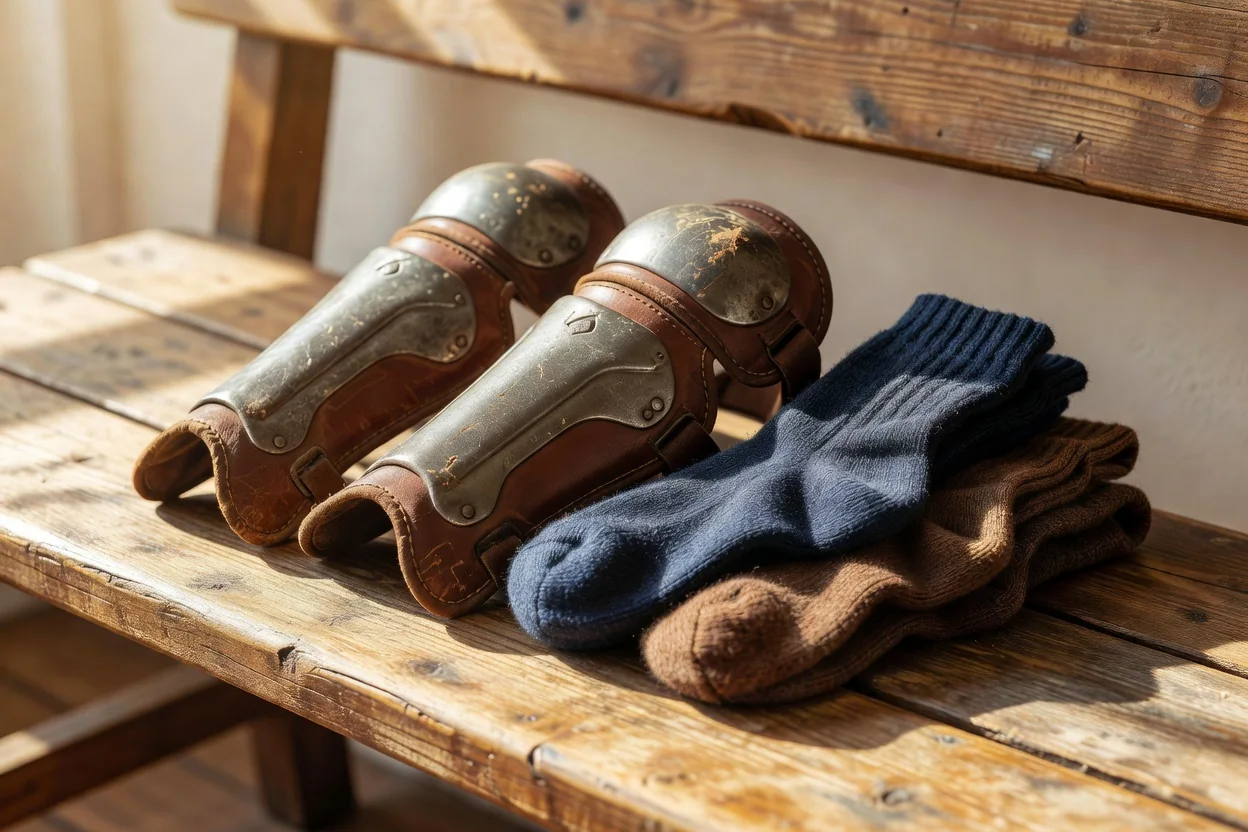
The arms race continues: ball panels are now wind-tunnel tested, boot soles are 3D-printed for individual feet, and manufacturers fight over grams. Yet every winter Sunday league match on a wet pitch quietly re-enacts 1930, mud and all, which is the vault's reminder that the game's soul predates its tools.
The vault's lesson is that football history is written in objects as much as in results. The next time a free-kick dips wickedly or a winger cuts inside on a dry night, credit the player, but spare a thought for the century of leather, latex and knitted fibre under his feet.
Keep digging in the vault

Offside: From Three Men to Millimetre Lines
A law written for schoolboys in 1863 has been rewritten three times, and each rewrite changed how football is played, coached and argued about.
2026-09-01
1992: The Back-Pass Ban That Changed Football Forever
One law change after a dire 1990 World Cup forced goalkeepers to become footballers. The modern game starts here.
2026-08-28
From Zero to Five: How Substitutions Changed the Game
For the first 90 years of organised football a tired or injured player simply played on. The road from zero substitutes to five rewired tactics.
2026-08-24