
1966 Final: England, West Germany and the Ghost Goal
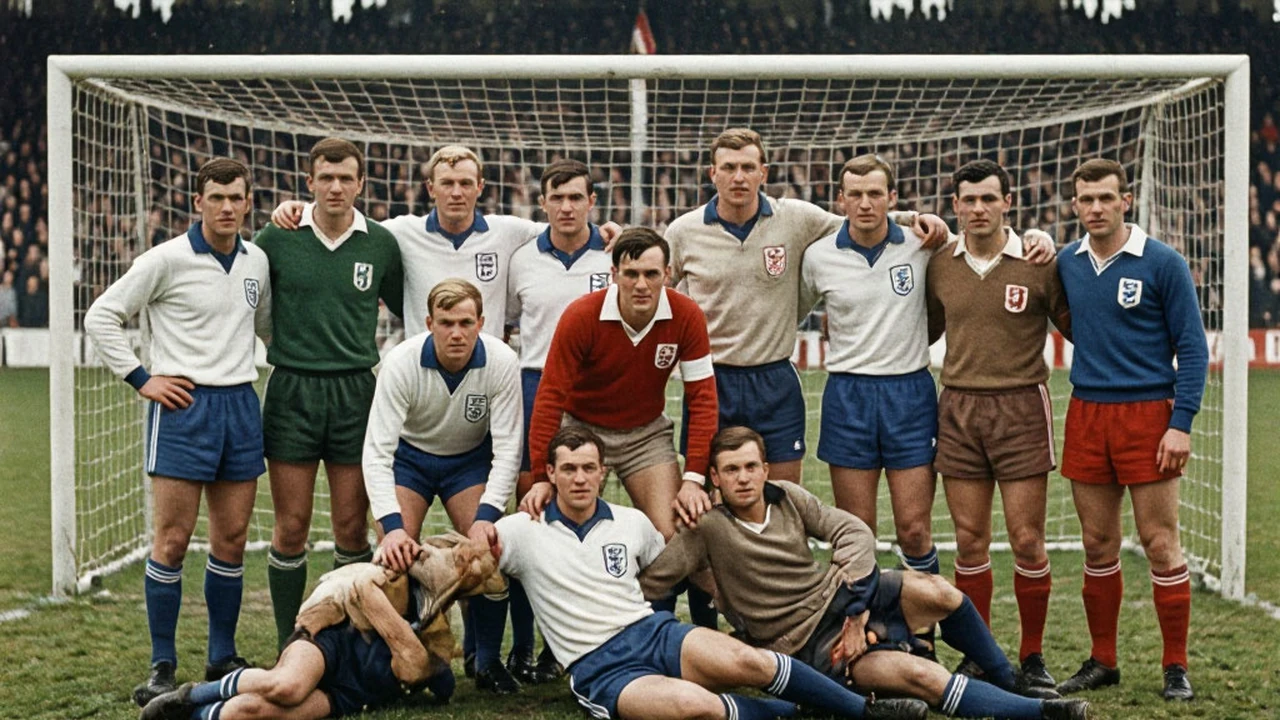
England have played one World Cup final, and they won it with the only hat-trick ever scored in one, on 30 July 1966, against West Germany at Wembley. The 4-2 victory after extra time gave the country its single greatest sporting afternoon, one genuinely immortal piece of commentary, and an argument about a ball crossing a line that has now run for sixty years.
Geoff Hurst's second goal, in the 101st minute, bounced down off the crossbar and was given. Germany still calls it the Wembley-Tor, the Wembley goal, with all the suspicion the phrase carries. The dispute is part of the match's immortality; the rest is simply great theatre.
How the final unfolded
West Germany struck first, Helmut Haller punishing a weak Ray Wilson header after 12 minutes. England answered six minutes later when Hurst glanced in Bobby Moore's quick free-kick, and the match settled into a tactical wrestle between Alf Ramsey's wingless 4-3-3 and Helmut Schon's side built around the 20-year-old Franz Beckenbauer, detailed to shadow Bobby Charlton all afternoon.
With 12 minutes left Martin Peters put England 2-1 up, and Wembley began to celebrate. Then, in the 89th minute, a German free-kick pinballed in the English box and Wolfgang Weber stabbed home the equaliser. Ramsey's message before extra time entered legend for its simplicity: look at them, he said, pointing at the prone Germans, they're finished.
- Haller opened on 12 minutes; Hurst equalised on 18 from Moore's free-kick.
- Peters made it 2-1 on 78 minutes; Weber forced extra time on 89.
- Hurst scored the disputed third on 101 minutes and the fourth in the final seconds.
- Bobby Moore lifted the Jules Rimet trophy before 96,924 spectators.
The ghost goal, examined
The 101st minute: Alan Ball crossed from the right, Hurst turned and drove the ball against the underside of the bar; it bounced down and out, and Weber cleared. Referee Gottfried Dienst of Switzerland consulted linesman Tofiq Bahramov of the Soviet Union, who signalled a goal. No camera angle has ever settled it conclusively. Modern analyses, including a well-known Oxford study using computer reconstruction, lean toward the whole ball not crossing the line, but the film is genuinely inconclusive, which is why the argument survives.
Bahramov, an Azerbaijani who became a national hero at home for other reasons, took his certainty to the grave, saying only that he believed what he saw. English fans named him in a folk song. Germans renamed the phenomenon of any disputed goal-line call after the stadium.
The last seconds
With Germany committed forward in the 120th minute, Moore picked out Hurst on the halfway line. As spectators spilled onto the pitch, Hurst carried the ball fifty metres and smashed it past Hans Tilkowski into the top corner, allegedly aiming for the crowd to waste time and mishitting it perfectly. BBC commentator Kenneth Wolstenholme supplied the soundtrack: "Some people are on the pitch. They think it's all over. It is now." Four-two, and the most quoted sentence in English broadcasting history was complete.
| Player | Final | Goals | Note |
|---|---|---|---|
| Geoff Hurst | England 4-2 West Germany, 1966 | 3 | Only final hat-trick in tournament history |
What the afternoon left behind
The win transformed its makers: Moore became the definitive English captain, Ramsey was knighted, and Hurst's hat-trick remains unmatched despite the finals played by Pele, Maradona, Zidane and Messi since. For Germany, 1966 was the prologue to a rivalry that would produce 1970, 1990, 1996 and 2010, usually with the roles reversed.

The tournament around the final had its own legends: North Korea beat Italy 1-0 at Ayresome Park in the biggest shock the competition had seen, and Eusebio's nine goals for Portugal, including four in the 5-3 quarter-final comeback against the Koreans, made him top scorer. Even the trophy had an adventure that summer, stolen from a London exhibition in March and recovered by a dog named Pickles a week before the tournament. Ramsey, who had promised England would win, was vindicated with the wingless system the press had mocked for two years.
One final, one hat-trick, one ghost goal and one immortal sentence of commentary: the vault needs nothing more to keep 30 July 1966 in the front row. England are still waiting for a second afternoon like it, which is precisely why the first one refuses to fade.
England have never returned to a World Cup final, which has only polished 1966 brighter. Every tournament failure is measured against the summer when the game's inventors actually won it, when a linesman's flag decided the most replayed moment in football, and when it was, in fact, all over.
Keep digging in the vault

England 3-6 Hungary 1953: The Match That Changed Football
The Match of the Century lasted 90 minutes and ended decades of English assumptions. One number 9 who did not play like a number 9 did the damage.
2026-08-31
Maracanazo 1950: When Uruguay Silenced the Maracana
Brazil needed a draw in the decisive match of the final round. Alcides Ghiggia had other ideas, and a stadium went silent for 70 years of retellings.
2026-08-27
Istanbul 2005: Liverpool and Six Minutes of Madness
3-0 down to a Milan side of Maldini, Kaka and Shevchenko. Gerrard, Smicer and Alonso scored in six minutes. Dudek did the rest in the shoot-out.
2026-08-21