
England 3-6 Hungary 1953: The Match That Changed Football

On a grey November afternoon in 1953, 105,000 people filed into Wembley to watch the masters of football teach the upstart Hungarians a lesson. Ninety minutes later England had lost 6-3, at home, to continental opposition for the first time in their history, and the sport's oldest football nation was forced to admit the game had passed it by. No friendly before or since has changed so much.
The Match of the Century, as the press immediately called it, was a tactical demolition carried out by Nandor Hidegkuti, Ferenc Puskas and a Hungarian side that had not lost in three years. Its consequences ran for decades.
What England believed, what Hungary knew
England in 1953 still played the WM formation as scripture: rigid positions, the centre-half locked onto the opposing centre-forward, full-backs who did not cross halfway. The team's reputation rested on the invincibility of Wembley and the authority of Billy Wright, the Wolves captain and symbol of the English game.
Gusztav Sebes' Hungary arrived with a heresy. Hidegkuti, wearing the number 9, played nowhere near England's centre-half Harry Johnston, dropping instead into midfield where no Englishman's job description allowed him to follow. Puskas and Sandor Kocsis attacked the spaces Johnston vacated. Within 90 seconds Hidegkuti scored, and England's defensive map was useless for the rest of the afternoon.
- Hidegkuti scored a hat-trick, the first coming after just 90 seconds.
- Puskas scored twice, including the drag-back goal that left Wright tackling empty grass.
- Bozsik drove in the sixth; England's replies came from Sewell, Mortensen and a Ramsey penalty.
- Hungary had 35 shots to England's five, on some contemporary counts.
Ninety minutes, goal by goal
The pattern was set early and never changed. Hidegkuti's opener after a minute and a half was followed by Sewell's equaliser, briefly 1-1 and briefly hopeful. Then the machine engaged: Hidegkuti again, Puskas twice in four minutes, and 4-1 by the 27th minute. Mortensen pulled one back before half-time, but the second half brought Bozsik's drive and Hidegkuti's third, with Ramsey's penalty a footnote at 6-3.
The Puskas goal on 24 minutes became the match's emblem. Receiving a cross from the right with Wright closing him down, he dragged the ball back with the sole of his boot so sharply that England's captain slid past into space like a man who had missed a train, and Puskas smashed the ball past Gil Merrick. Geoffrey Green of The Times wrote that Wright rushed at him "like a fire engine going to the wrong fire."

Budapest confirms it: 7-1
English football's consolation that evening was that it had been a fluke. The return fixture in May 1954, in the Nepstadion before 92,000 Hungarians, removed that comfort: 7-1, still the heaviest defeat in England's history. Kocsis scored twice, and the only English goal came from Ivor Broadis. Two matches, thirteen Hungarian goals, and the argument was over.
| Date | Venue | Score | Hungary scorers |
|---|---|---|---|
| 25 Nov 1953 | Wembley, London | 3-6 | Hidegkuti 3, Puskas 2, Bozsik |
| 23 May 1954 | Nepstadion, Budapest | 1-7 | Kocsis 2, Puskas, Lantos 2, Toth, Szucs |
The long consequences
The defeat forced English football into its first honest self-examination. Coaching education, previously treated with suspicion, gained ground through figures like Walter Winterbottom and later Alf Ramsey. Tactical flexibility, the idea that a player's role could differ from his shirt number, entered the English mainstream. When Ramsey won the World Cup in 1966 with wingless midfielders doing multiple jobs, the line back to Wembley 1953 was direct.

The defeat was all the more bruising because England had spent decades declining to test themselves abroad: the FA stayed out of FIFA for years and skipped the first three World Cups entirely, judging the domestic game superior by default. Centre-half Harry Johnston, dragged across Wembley by Hidegkuti all afternoon, admitted afterwards he had never faced anything like it. Walter Winterbottom, the manager with no control over selection, spent the next decade pushing for the coaching revolution the result made unavoidable.
The vault files it under matches that taught more than any trophy: 6-3 at Wembley, then 7-1 in Budapest, and an entire football culture forced to modernise. No friendly has ever carried such consequences, and none ever will again.
For Hungary the match was the coronation of the Mighty Magyars, whose full story sits elsewhere in the vault. For everyone else it was proof that football intelligence beats football tradition. A friendly on a Wednesday afternoon rearranged how the game's inventors thought about the game, which is why, of all the famous results in this archive, 6-3 at Wembley might be the most consequential.
Keep digging in the vault
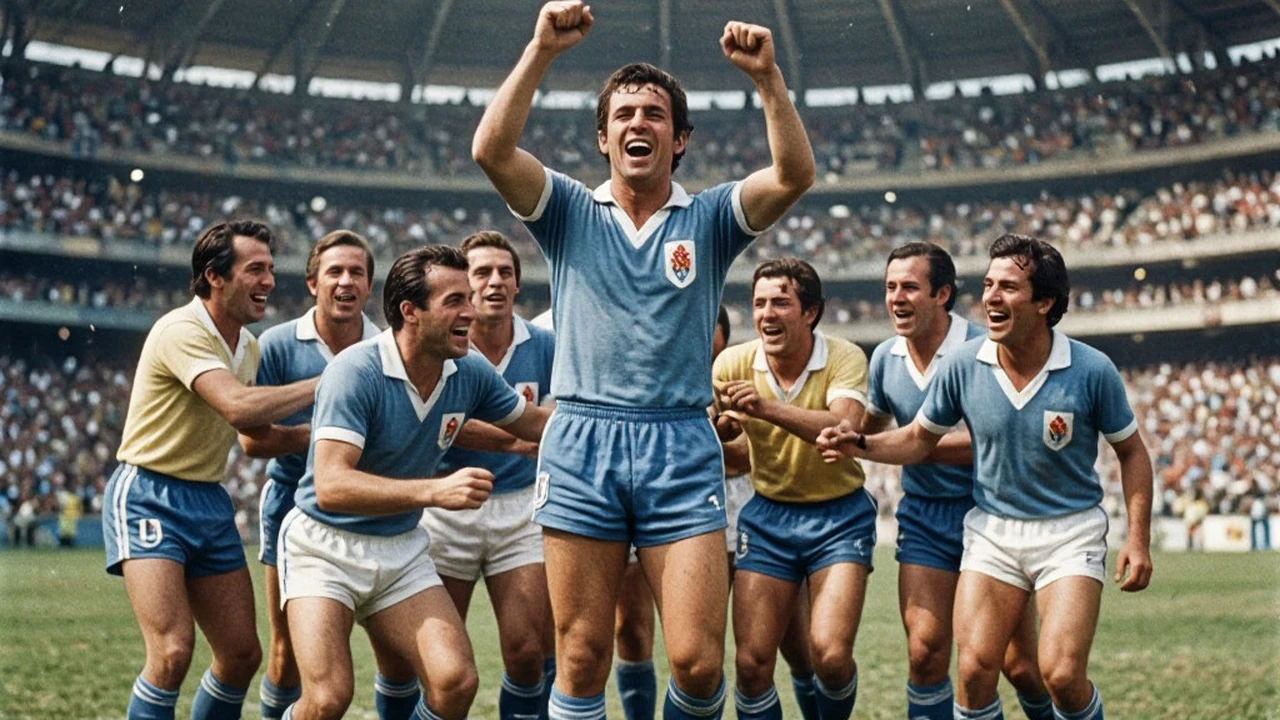
Maracanazo 1950: When Uruguay Silenced the Maracana
Brazil needed a draw in the decisive match of the final round. Alcides Ghiggia had other ideas, and a stadium went silent for 70 years of retellings.
2026-08-27
1966 Final: England, West Germany and the Ghost Goal
Did the ball cross the line in the 101st minute? Wembley still argues. What is not argued: Hurst remains the only man with a final hat-trick.
2026-08-24
Istanbul 2005: Liverpool and Six Minutes of Madness
3-0 down to a Milan side of Maldini, Kaka and Shevchenko. Gerrard, Smicer and Alonso scored in six minutes. Dudek did the rest in the shoot-out.
2026-08-21